Agntc.me
AI editorial engine that helps newsrooms publish 10x more without losing their voice.
View Live SiteDuration
4 months
Role
Founder / Designer / Developer
Tools
Figma, Next.js, Tailwind CSS, OpenAI API, Anthropic API, Sanity CMS
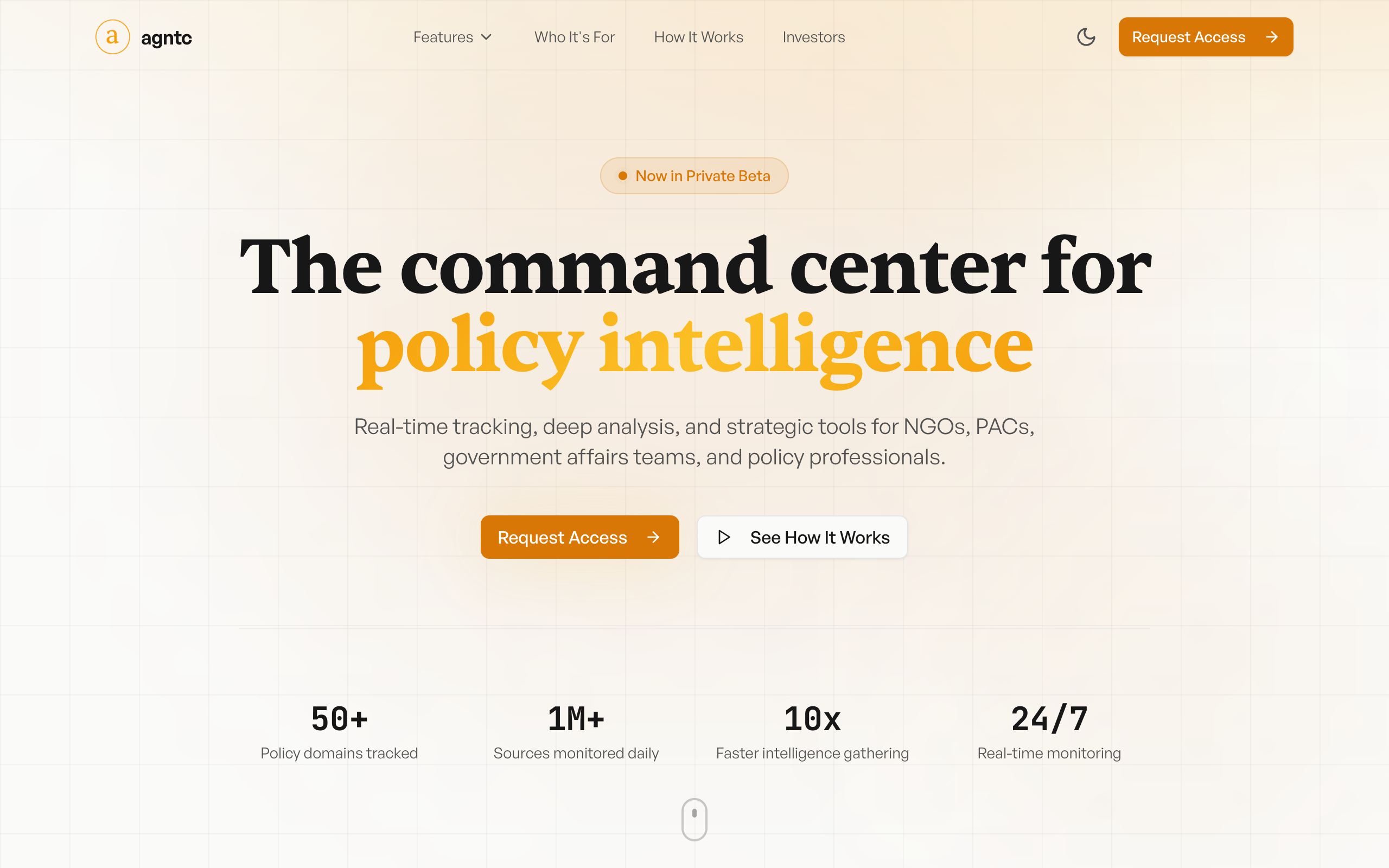
Live at agntc.me
The Problem
Newsrooms are drowning. They need to publish more content to stay relevant, but quality journalism takes time. Generic AI tools produce generic content that sounds nothing like the publication.
The result: either burnout trying to keep up, or surrendering voice to algorithms.
Agntc solves this by combining AI capabilities with editorial guardrails — enabling 5→50 articles per week while maintaining the publication's distinct voice.
80%
Time saved on drafts
5→50
Articles per week
1-click
CMS publishing
How It Works
1. Source Aggregation Connect RSS feeds, paste URLs, or let the system discover relevant coverage. Agntc monitors sources and surfaces what matters.
2. Intelligent Analysis For each source, AI extracts facts, identifies quotes, and flags what's actually new versus rehashed content.
3. Angle Selection Instead of generating one article, Agntc proposes three distinct angles. The editor chooses direction — AI doesn't decide what's newsworthy.
4. Voice Consistency Publication profiles capture style, tone, and editorial standards. Every draft sounds like your publication, not ChatGPT.
5. Editorial Guardrails Built-in fact verification prompts, legal review flags, and source attribution. AI assists; humans verify.
6. One-Click Publishing Direct integration with Sanity CMS. Review the draft, click publish, done. Full audit trail maintained.
Design Philosophy
AI as tool, not author — The interface emphasizes human decision-making at every step. AI generates options; editors choose.
Transparency over magic — Users see exactly what the AI analyzed, what sources informed the draft, and what confidence levels apply. No black boxes.
Speed without sacrifice — The dashboard is optimized for rapid triage. Keyboard shortcuts, batch operations, and smart defaults reduce clicks without hiding complexity.
Editorial-grade UI — Dark mode by default (editors work long hours), information-dense layouts, and clear status indicators for the publish pipeline.
Technical Stack
Frontend — Next.js with App Router, Tailwind CSS, and shadcn/ui components. Real-time updates via server-sent events.
AI Pipeline — Multi-model approach using OpenAI for analysis and Anthropic for generation. Custom prompting with publication context injection.
Content Management — Sanity CMS integration with custom publishing workflows and approval chains.
Infrastructure — Edge functions for low-latency AI calls, background jobs for source monitoring, and webhook-based CMS sync.
Key Screens
Dashboard — Pipeline view showing articles in progress: sources being analyzed, drafts awaiting review, content ready to publish.
Article Editor — Side-by-side view with source material on left, generated draft on right. Inline editing with regeneration options.
Source Manager — Configure RSS feeds, add one-off URLs, set monitoring frequency. Visual indicators for source health.
Publication Profile — Define voice, style guidelines, and editorial standards. Test prompts to calibrate AI output.
Analytics — Track publish velocity, edit rates, and time savings. Identify which sources produce the best content.
Outcome
Agntc.me is live and powering content production for Bugle.ie — proving the concept works in production.
What I shipped: • Complete AI editorial pipeline from source to publish • Multi-model AI integration with custom prompting • Real-time dashboard with publish queue management • Sanity CMS integration with one-click publishing • Publication profile system for voice consistency
The project demonstrates that AI can augment journalism without replacing editorial judgment — when the system is designed with guardrails from the start.